What I Learned at MD Anderson
Last weekend I went to Houston to attend MD Anderson’s Oncology Training Conference for Yoga and Mind-Body Teachers. The conference was co-hosted by the Texas Yoga Association. It was fantastic and I learned A LOT. I’d like to share the highlights with you here.
The University of Texas MD Anderson Cancer Center is one of the premier cancer care centers in the world. They focus not only on patient care, but also on cancer research. And as far as I can tell, everyone who works there is very smart, very compassionate, and eager to share everything they know to help improve care and resources for cancer patients and people who are touched by cancer.
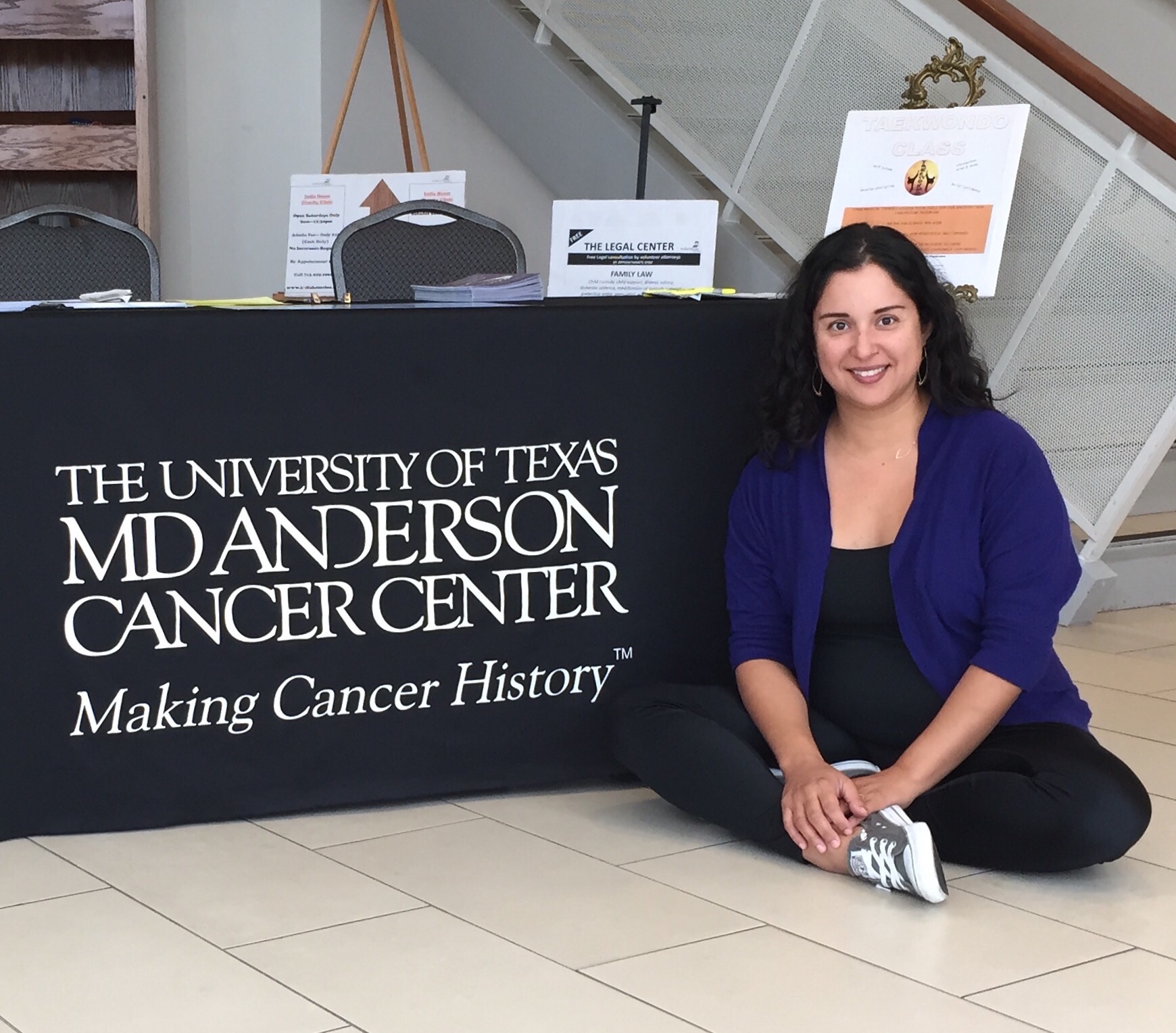 The training was hosted by the Integrative Medicine Program, which is the department within MD Anderson that offers complementary modalities, such as yoga, meditation, tai chi, music therapy, massage, acupuncture, and more, as part of the care plan for cancer patients.
This group not only offers these complementary healing modalities for patients and anyone touched by cancer, but they also perform on-going research to understand exactly how the complementary therapies can help.
Medical and Neuroscience Experts
One of our first speakers was the Medical Director of the Integrative Medicine Program, Gabriel Lopez, MD. He taught us Cancer 101. I learned about the characteristics of different types of cancer, how some cancers grow quickly and some grow slowly, and which of these is more difficult to treat. I learned about cancer staging and how cancer can metastasize in different parts of the body and whether and how those mets can be treated. I learned about the different cancer treatments, how they can be administered before or after surgery, and their common side effects.
Another of the speakers, Sarah Prinsloo, PhD, a neuroscientist at MD Anderson, taught about the brain, brainwaves, and the findings of many yoga and meditation studies. Most interesting to me were her studies where she used neuroimaging to study how guided imagery and meditation help cancer patients and survivors manage the symptoms of their treatments and reduce their healing time.
The engineer/science part of my brain really enjoyed these two presentations.
Mind-Body Experts
Another excellent aspect of the conference was that the Mind-Body teachers from MD Anderson, Alejandro Chaoul, PhD, Smitha Mallaiah, and Rosalinda Engle, taught us how specifically to teach yoga for people who are in cancer treatment or in recovery. They offered practices and held a panel discussion (two yoga and meditation teachers, two doctors, and an occupational therapist) about Precautions and Contraindications in the yoga practice.
A lot of what they taught is what we at The Yoga Room already do in our Gentle classes: modify the practice. Depending on what a person has going on in their body, we adjust the practice to suit the practitioner. Even still, I learned many new ideas to refine what we already know. And I was very grateful for the opportunity to ask some questions of the panel and hear their recommendations for how we as yoga teachers can create strong relationships with oncologists and other doctors in our area.
In a Nutshell
I think this training was spectacular. Outstanding. Every speaker was top-notch, and every message was on point. If I have to put the overall message in a nutshell, this is it:
Stress (whether due to work, family, disease, medical treatment, or anything else) contributes to disease and can prevent or slow healing.
Mind-Body practices such as yoga and meditation promote health by creating more alpha brain waves and training the brain to continue creating more alpha brain waves.
Increasing the alpha waves reduces stress and increases and ease and relaxation.
The reduction of stress and subsequent increase in ease and relaxation promotes health in the body, which for healthy people means lowering their risk of disease, and for people who are sick means that they create an environment within their bodies that more is conducive to healing.
With regular Mind-Body practices, such as yoga and meditation, cancer patients experience less pain, faster recovery, lower instances of their cancer spreading to a different part of the body, decrease in anxiety and negative emotions, better sleep, and improved memory and cognitive functions (chemo brain).
This is so powerful.
My Conclusion
My personal conclusion from the training is that as yoga teachers and yoga practitioners, we intuitively understand the benefits of yoga. We experience relaxation, mental clarity, improved mood, improved sleep, and more. But the good people at MD Anderson are proving, quantitatively, with their numerous scientific studies that are published in medical journals, the benefits of yoga for cancer patients.
This is so powerful.
Not just for cancer patients, but for everyone. Healthy or sick, we can all benefit from yoga. Yoga for EveryBody.
I love this.
 XO,
Zelinda
XO,
Zelinda
P.S. Please let me know if you'd like any additional information about Yoga for Cancer or anything I learned at MD Anderson. I'd love to hear from you!
Your Teacher is Going on Vacation. Don't Panic!
I know it can be really disappointing when your regular yoga teacher is absent from her class. Maybe she had a last minute emergency, or maybe it was a long-planned vacation. It’s important to acknowledge when this feeling comes up. The feeling is perfectly normal, and it's also a great opportunity for yogic inquiry and personal growth.
There are typically two ways that you end up with a sub teacher. Either you know in advance that your teacher is going to be away, or you walk into class expecting to see your teacher and are surprised to find another teacher at the front of the room.
If you know in advance that your favorite teacher is going to be away, you may be tempted to skip class, or you may decide to attend anyway but feel wary of the sub.
If you walk into class expecting to see your regular teacher and find someone else at the front of the room, you might feel a pang of stress or uncertainty, or you might even be tempted to turn around and walk out.
First, it’s important to recognize that it’s normal to feel unsettled when something is new, different, or unexpected.
Recognizing your situation is part of the yogic practice called svadhyaya, which means self-study in Sanskrit. Svadhyaya is one of my personal favorites because it provides unlimited potential for personal growth.
Once you recognize your situation, you can move forward to practice another yogic concept: equanimity.
Equanimity is practicing and learning to be comfortable and peaceful, even in unknown, uncertain, or uncomfortable situations.

On the yoga mat, for example, we practice equanimity when we try to remain peaceful in a pose doesn’t work for our body. We have options: we can modify the pose, we can take a break, or we can do a different pose. The real trick is to figure out how to be ok with doing some different than or even “less than” what is expected.
So then, in the example of when your regular yoga teacher is absent, how can you practice equanimity?
First, recognize that it can be challenging for both the students and the sub because each doesn’t know what to expect from the other.
Naturally, your substitute teacher's style will be different than that of your regular teacher. It’s a perfect opportunity to practice being peaceful and ok in an uncertain situation. Know that the teacher may use different language or may lead you into poses in a different way, but it doesn’t mean their teaching is better than or worse than, it’s just a different.
There is always something to learn from a new teacher, even if it's not what you were expecting to learn. The challenge is to be open to whatever it is the teacher offers.
Maybe you’ll learn how to get into a pose that was previously inaccessible to you, maybe you’ll learn a new variation or modification of one of your favorite poses, maybe you’ll learn a new subtlety about breathing, or maybe you’ll learn that there’s challenge and benefit in learning how to practice more slowly. The potential learnings are truly infinite.
So I encourage you, the next time your regular teacher has to miss a class, be open what you can learn from the sub. You might just learn something special that shifts your awareness or transforms your practice.
 XO,
Zelinda
XO,
Zelinda